

A celebration 200 years in the making
Did you know Locomotion No. 1, the world’s first passenger locomotive, has already travelled all the way to Japan?
Locomotion No.1 is world famous because of its pioneering journey on the Stockton & Darlington Railway 200 years ago. But Locomotion No.1 legacy also connects the UK to Nagoya. As Hitachi Rail’s Railway 200 celebrations continue, including saving the world’s first train station and hosting Locomotion No.1 at its factory Open Day, this story reveals how a North East engineer became part of Japan’s rail heritage.
In a conversation with Jim Rees from Friends of the Stockton & Darlington Railway, Hitachi uncovers a remarkable tale of North East and Japanese collaboration and rail heritage.
The birth of the Locomotion No.1
Originally built for the opening of the Stockton & Darlington Railway in 1825, Locomotion No.1 marked a pivotal moment in history. As the first steam locomotive to haul a train on a public railway, it gave birth to modern railway which transformed industries, societies, and economies around the world.
To commemorate the 150th anniversary of the railways, a fully operational replica of Locomotion No.1 was created for Beamish Museum’s 1975 celebrations. This faithful recreation became more than just a tribute. It evolved into a living artefact of industrial heritage, creating its own international legacy in Japan.
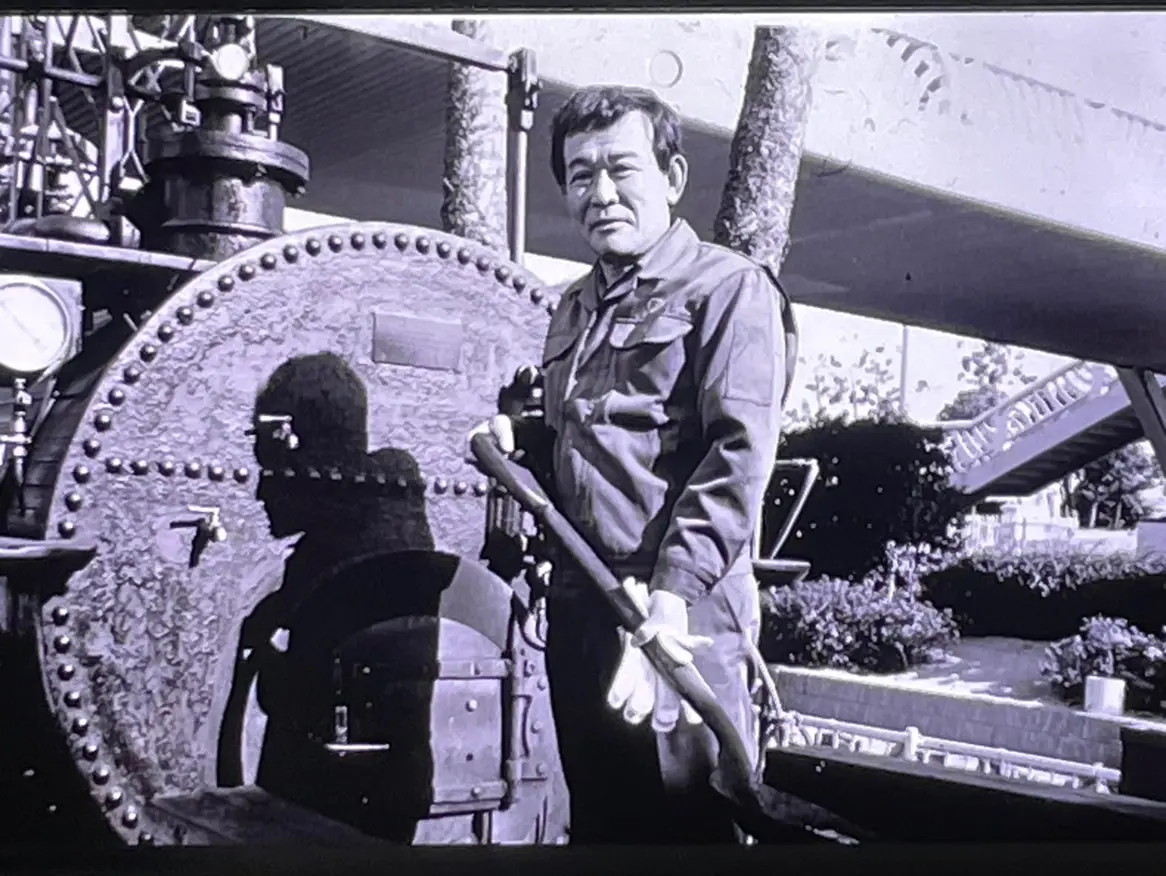
Japan Calls – An unlikely international chapter
In 1989, Japan hosted the International Design Exposition in Nagoya, a vast showcase of history, technology, and future-facing design. Due to Japan’s passion for rail heritage, organisers inquired if the Locomotion No.1 replica could appear as a living exhibit. An agreement was made, with the replica sent across the world, along with British technicians, tasked with teaching Japanese engineers how to drive it.
Jim Rees was one of the British technicians who travelled to Japan with the replica Locomotion No. 1. When he arrived in Nagoya, he found himself faced with quite a challenge, training a team of Japanese railway engineers, most of whom were used to more modern Victorian locomotives but not the quirks of a much earlier machine.
To bridge the technical and language gaps, Jim resorted to hand-drawn diagrams sketched, with the help of a generous but non-technical translator. Among the trainees was Mitsuo (pictured above), a spirited and experienced driver who quickly became a good friend.
To mark the occasion of the Locomotion No. 1 being sent to Nagoya, a temporary station was built with a sign that proudly read: “Stockton and Darlington Railway, Nagoya Branch.” Jim stayed for several weeks, helping the team get to grips with the locomotive. The Japanese public, in turn, welcomed the engine with great enthusiasm many describing it as a “great treasure of England.”
Locomotion as living heritage
Jim Rees believes the enduring charm of Locomotion No. 1 lies in its humanity. "Steam engines are like humans: they're warm, temperamental, and keep going under appalling conditions," Jim highlights. Railway200 offers a chance to reconnect with that mechanical spirit, one that launched humanity from the limits of animal power into a new industrial age.
Visitors to Hitachi Rail’s Open Day or Locomotion No.1 anniversary journey experienced this first-hand. "You see two little beam engines going for a walk," Jim notes, describing the awe and disbelief early passengers must have felt when realising fire and steam could move faster than a horse.
As we mark 200 years of Locomotion No 1’s first journey on Stockton & Darlington Railway, it also celebrates rail heritage that links the UK and Japan.
These ties remain strong today, with Hitachi both building UK’s first battery trains in the North East and helping to safeguard the oldest station in the world at Heighington. On 4 October, visitors rode Locomotion No.1 at Hitachi’s Newton Aycliffe Open Day; they did not just see a steam locomotive but experienced a moment when the world changed forever.