
Want to learn more?
To find out more about our ticketing services please visit our ticketing & payment page.

The Grand Paris Express is currently the largest urban project in Europe. The new automatic metro lines 15, 16, 17 and 18 will connect the main residential and business hubs of the Paris suburbs and will benefit nearly 3 million daily passengers. By 2030, the project foresees the commissioning of 68 stations and 200 km of automatic lines, mostly underground. These infrastructures will serve major activity centers (airports, business districts, university and research campuses) as well as metropolitan areas that are currently difficult to access. The Grand Paris Express aims to be more pleasant, faster, and a generator of opportunities, by facilitating access to jobs, education, culture, and leisure.
Hitachi Rail is a key player in this project: its ticketing division will provide the ticketing systems for the new lines. The commissioning of the first stations began in 2024, before the Paris Olympic and Paralympic Games, and will continue until 2030. The Grand opening of the first Metro stations, Orly Airport and Saint-Denis Pleyel took place on June 24th 2024, just in time for the Olympics. Hitachi Rail plans to install nearly 500 ticket vending machines and 1,200 access gates together with the company IER.
As part of a partnership with Siemens Mobility, Hitachi Rail will also supply the Control Centers (centralized supervision of traffic, energy, auxiliary equipment, and information systems) for lines 15, 16 and 17, as well as trackside equipment and the secure communication network. In addition, Hitachi Rail and its partners will equip the trains of the first three lines of the project, ensuring the design and deployment of onboard systems.
In this interview, Jérôme Vinot, Ticketing Project Manager for the Grand Paris Express, looks back on the major stages of the project and explains how ticketing solutions are at the heart of tomorrow’s mobility challenges.
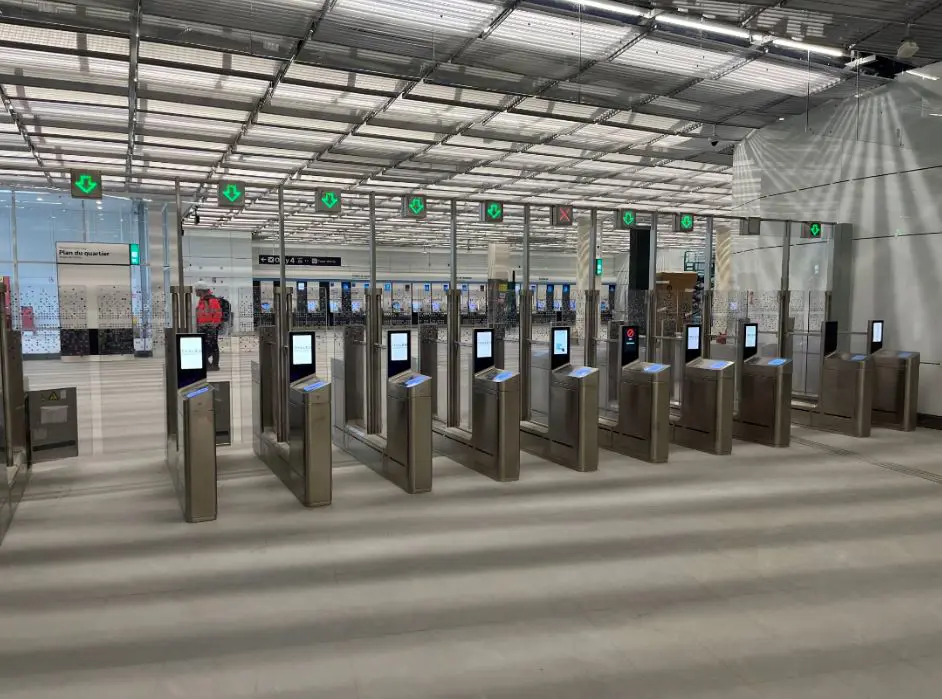
The contract was signed in 2021 with the “Société du Grand Paris” which has since become the “Société des Grands Projets”(SGP). It covers ticketing for the four Grand Paris Express lines: 15, 16, 17 and 18. In total, 60 stations must be equipped with ticket vending machines, access control devices and a system enabling full interoperability with other transport modes deployed in Île-de-France.
One of the major challenges was the early opening of the Orly Airport station (south) and Saint-Denis Pleyel station (north) in June 2024, before the start of the Paris Olympic Games. This deadline was not initially included in the contract and required an acceleration plan. Thanks to close coordination among the many contractors involved, this objective was achieved.
The aim of this project is to facilitate suburb-to-suburb travel and thus reduce the use of cars or taxis, aligning with an ecological approach to lowering carbon impact.
The opening of the Orly station for the Olympic Games had a considerable impact. Located directly inside the airport, it allows travelers to quickly access the metro to reach central Paris.
During deployment, it was necessary to adapt to the context of an international sporting event, with strong constraints on the urban environment. Before the Games began, five additional vending machines were urgently installed to cope with the influx of travelers, and Île-de-France Mobilités also requested functional upgrades to improve the passenger experience, following feedback from the first days of operation.
As part of this project, the SGP enlisted renowned architects and artists to design stations that are both aesthetic and integrated into their environment. The design agency Patrick Jouin iD defined precise specifications regarding machine ergonomics, colors, external appearance and accessibility for people with reduced mobility. All these requirements were met.
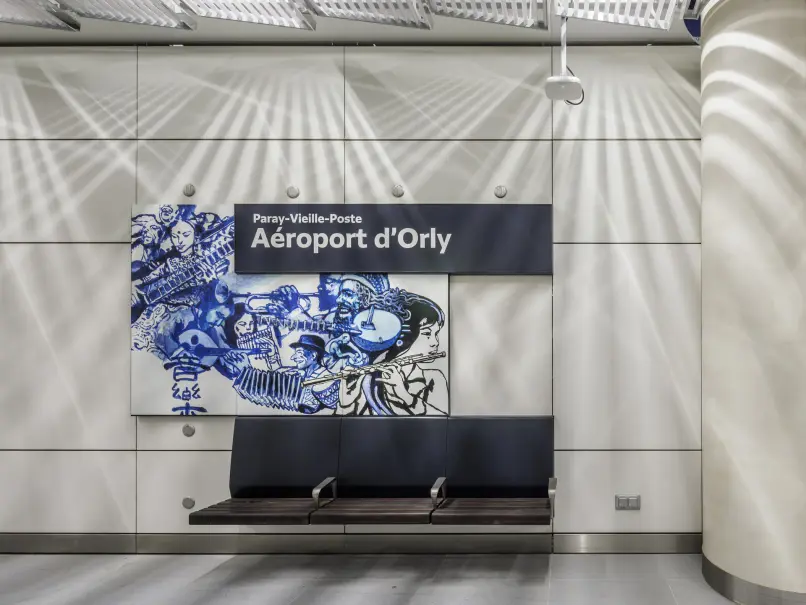
Our ticketing solutions contribute to seamless mobility. Beyond the transport card, travelers can also use their Android and Apple smartphones equipped with the IDFM application. Station access gates will be able to integrate EMV technology (MasterCard and Visa), allowing entry to the network via direct payment with a bank card. A first pilot could be launched in spring 2026 at Orly station.
The project was first structured around a generic design phase: defining a global model, then deploying it on each line.
With the Olympic deadline, the contract structure was adapted to allow the early opening of the two stations at Orly and Saint-Denis Pleyel, followed in January 2025 by Villejuif Gustave Roussy station, where a rapid adaptation to the new regional fare policy (single fare in Île-de-France) was implemented.
The next steps include:
Commissioning of the first section of line 18 (4 stations) on October 1, 2026.
Opening of the first section of line 15 South on April 30, 2027 (16 stations).
First sections of lines 16 and 17, scheduled for late 2027.
Full deployment expected by 2030.
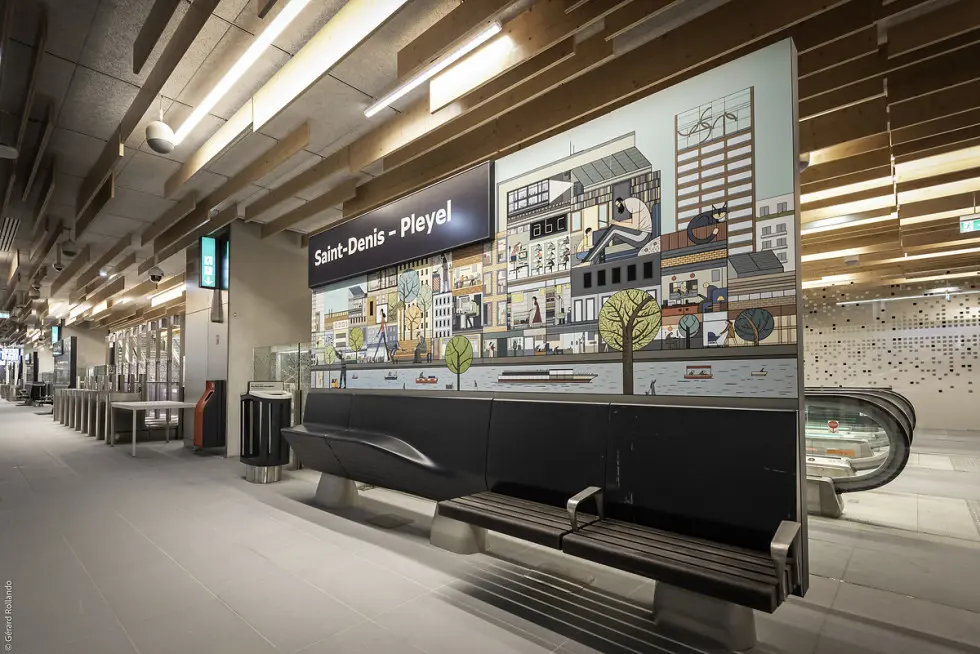
The Grand Paris Express is the largest infrastructure project in Europe: 200 km of automatic lines accessible with a single transport ticket, interconnected with the existing network (Metro, Tram, RER, Transilien) and the future Île-de-France cable car (opening December 13, 2025), in which Hitachi Rail is also involved.
These new lines will be fully interoperable with the rest of the Île-de-France Mobilités network. With a single transport ticket, travelers will be able to move everywhere, regardless of the mode of transport used. This project will reduce travel times and encourage more sustainable mobility, less dependent on cars.